
The library is my bookshelf. It started as a spark, nothing more. Maybe I was looking at my own shelves, maybe I was holding a book I’d brought home from the library, I honestly can’t say which. Just a clever little turn of phrase that landed and wouldn’t leave. I keep coming back to it, and the more I sit with it, the more it feels less like a clever line and more like a way of living I’m slowly growing into.
The more I follow the spark, the more I think what it really means is this: the library is an extension of my house. Another room I can slip into quietly and just be curious in, no one needing anything from me, everyone else off in their own corner doing the same. It connects the small place I live to a much larger one, full of shelves I could never hold on my own, and full of people I’ll never meet, all of us borrowing from the same rooms. And here’s the part that keeps pulling at me. When the library can hold the abundance, I don’t have to. The books that stay on my own shelf get to mean more, because they’re no longer everything I’ve accumulated. They’re what’s left after the library carried the rest.
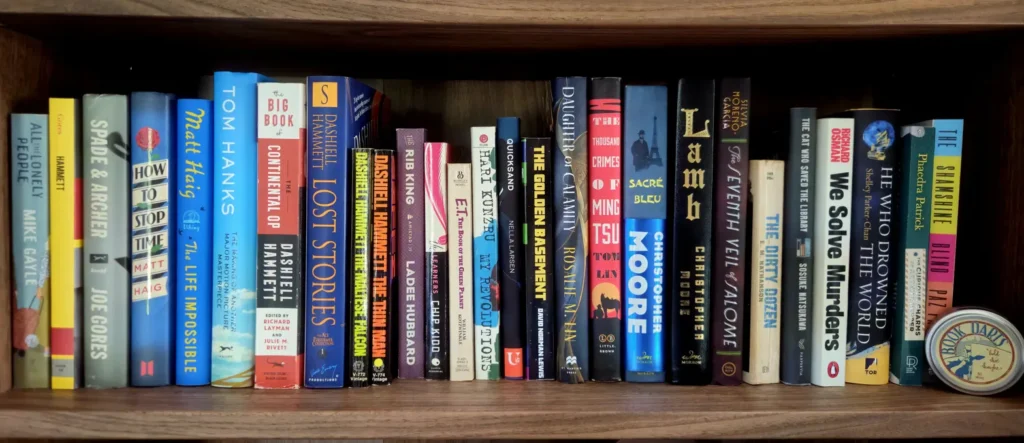
I’ve been drawn to slow living for years now, to the idea of doing less but doing it more deliberately, of leaving enough room in a life to actually feel it. For me it comes down to two words, flexibility and accessibility, though I’m not there yet and I won’t pretend otherwise. It’s a direction I’m walking in rather than a place I’ve arrived, but it’s the direction that feels right, and wanting to own less is part of it.
Part of it is practical, too. Our house is small and the shelf space is limited, so the library becomes the room my house doesn’t have.Part of it is practical, too. Our house is small, the shelves fill up faster than I’d like, and there’s only so much room before books start stacking on the floor. The library becomes the room my house doesn’t have.
If I want a book, I can walk into the library and find it there, as if it were my own home library, except I don’t need the shelf space to hold it all. That’s the feeling, really, the book just there, available, waiting for me to come and get it. Well, unless there’s a long wait list, but you get the idea.
For now I only have the one card, Sacramento Public Library, here in California. But a library card doesn’t look like much, and it’s really a key. This one already opens every branch in the system, any shelf in any of them, without my owning a thing on those shelves. That’s the quiet magic of it. I use it constantly, mostly for audiobooks and ebooks through Libby, the library’s free borrowing app, which I lean on more than I ever expected to. And I want more than one key. Every library system is its own set of rooms, each branch with its own light and quiet and character, and another card would open a whole new set of doors. I’d love to join more of them, here and wherever I end up, until almost any library’s rooms were open to me. Not to collect the cards. To walk into the rooms.
I haven’t given up on physical books, though, far from it. I love them in every form, the audiobooks and the ebooks and the paper ones, but lately what I want most is to check out more physical books from the library, to be in the building, among the shelves and the quiet, in a way that borrowing from my couch will never quite replace. Maybe that’s a thread for another time, wandering into different branches and writing them up the way I would any other place worth visiting.
Every so often, a book I’ve borrowed turns into one I have to own. That’s what happened with the March trilogy, John Lewis’s graphic novel about the civil rights movement, written with Andrew Aydin and drawn by Nate Powell. I borrowed all three volumes from the library first, and they moved me so completely that I went out and bought the boxset to keep. Not every book asks to be kept like that. Most I’m glad to borrow and give back. For now it’s enough to say the library is where I met them.
There was one branch I’d been circling for a while without ever going, the Ella K. McClatchy Library. It lives inside a historic home, a house the McClatchy family gave to the city of Sacramento in 1940 so it could become a library. Sacramento keeps doing this to me, opening up in ways I didn’t expect, the longer I pay attention to it. The first time I saw the branch on Instagram I couldn’t look away, because I have always loved old houses. It reminded me of Sundance Books, one of my favorite bookstores, cozy and warm, which I only visited once before it closed for good. And McClatchy was only a mile and a half from my door. For the longest time, I still hadn’t gone.
So today I finally went.
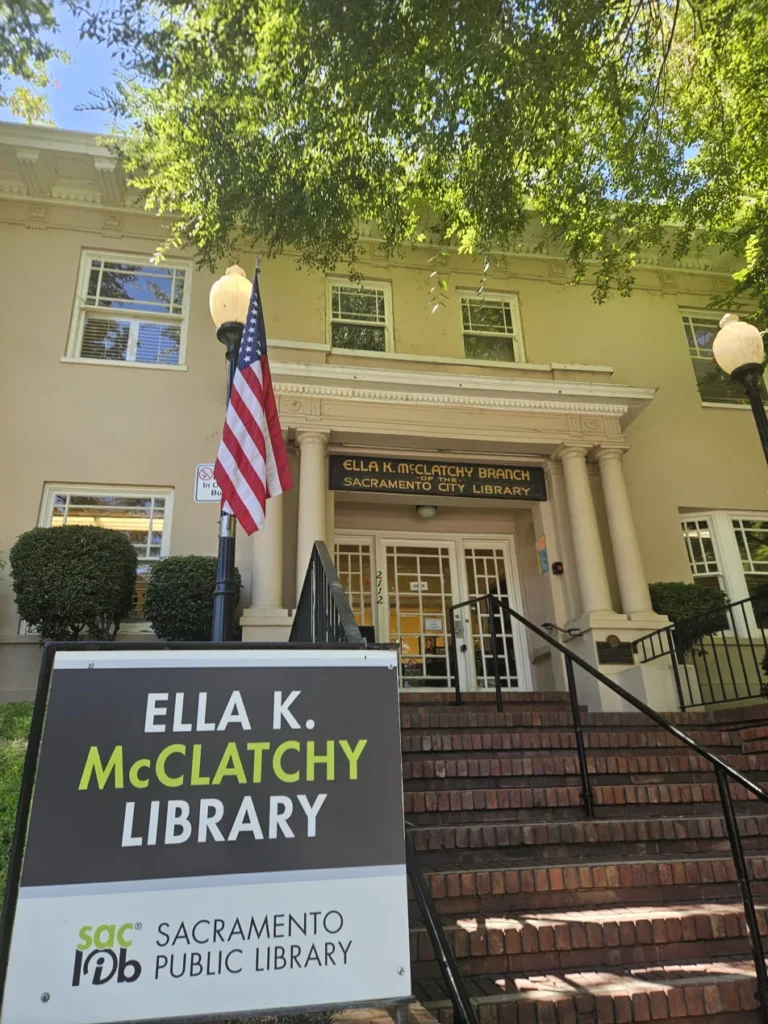
We walked up the exterior stairs and through the front door, where the librarian and the security guard both greeted us like guests arriving at someone’s home, which, in a way, we were. Inside it was warm and cozy, wood floors soft underfoot, the walls bright and hung with photographs from the building’s history. Not a lobby, a foyer. The house has never quite stopped being a house.
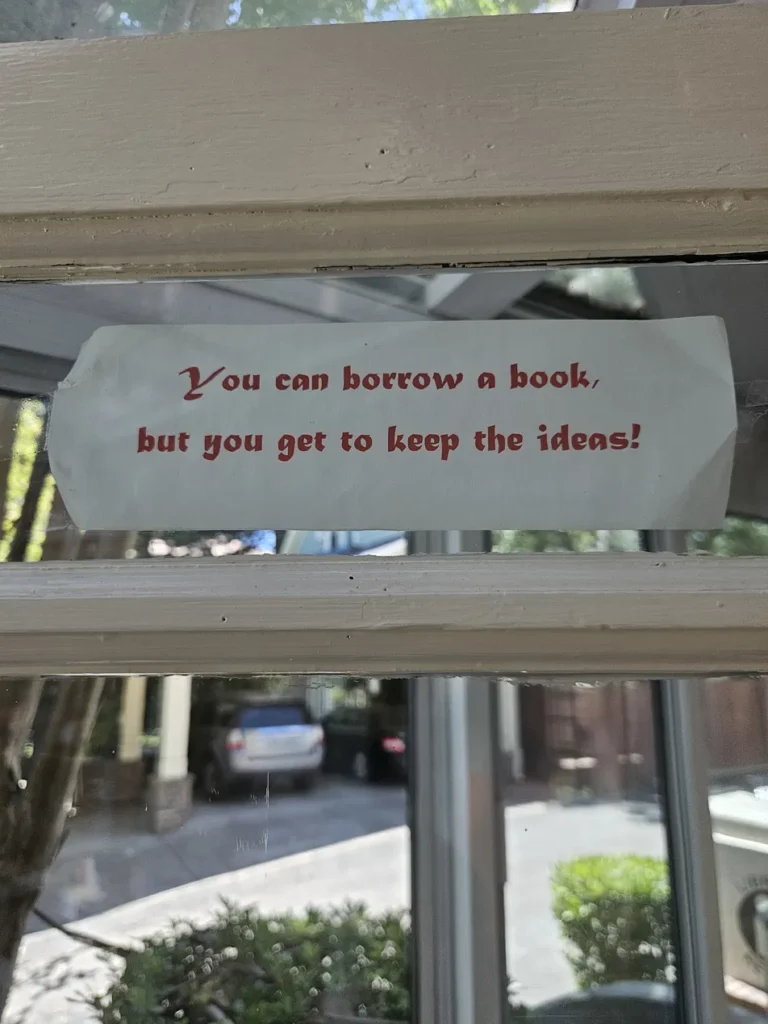
We wandered the downstairs room by room, in no hurry, until we reached the sunroom, lit warm and gold on a sunny afternoon, where the library keeps a few books for sale. Someone was already settled inside, deep in a book, and I didn’t want to break that, so I left them to it and took no picture. But by the entrance there was a little handwritten sign, and it stopped me: You can borrow a book, but you get to keep the ideas.
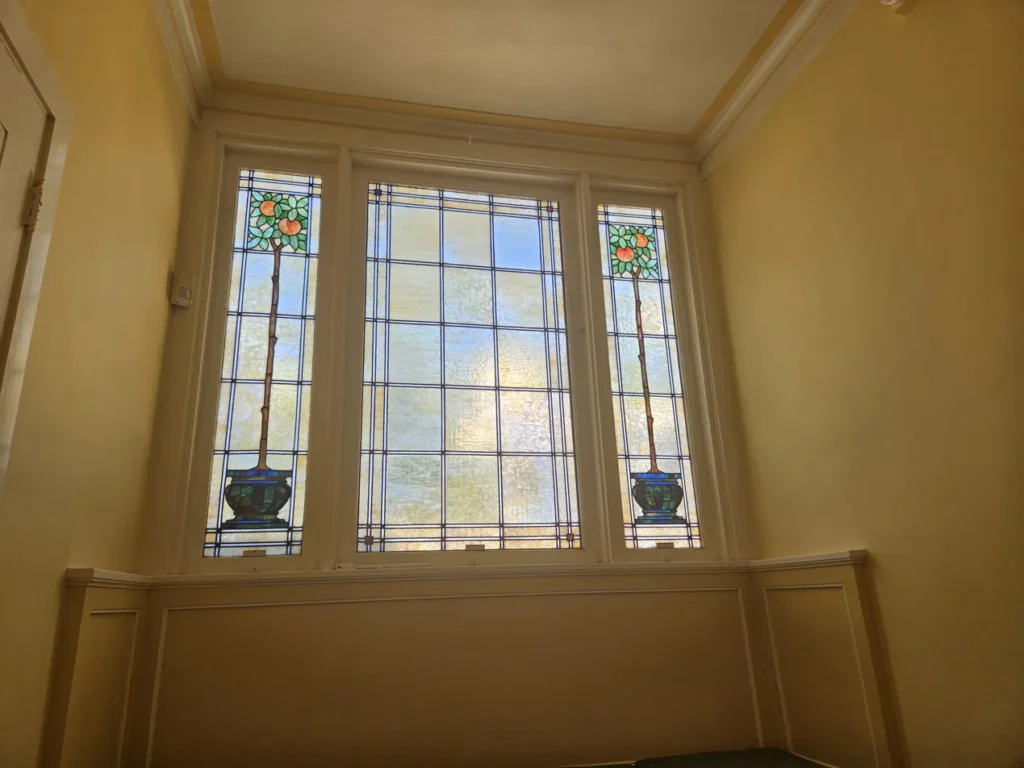
Then we started up the stairs, and the stained glass on the stairway window stopped me all over again. Orange trees rising out of deep blue urns, set in leaded glass, the afternoon light coming through soft and patterned. I’d first seen it on Instagram, the image that made my heart pound, and here it was in front of me, exactly what I’d hoped for, which almost never happens with a place you’ve imagined for that long.
Upstairs there were no bookshelves at all, just community rooms and quiet spaces where the bedrooms used to be. People were tucked into nearly every one, each in their own corner, the way a house feels when everyone’s home and happy to be left alone together.
And that’s when it caught me. The whole time I’d been calling the library my bookshelf, a home for books I don’t have to own, and here I was standing inside a literal home. A family gave their actual house to the city so it could hold everyone’s books instead of just theirs. I went looking for a metaphor and walked straight into the real thing. I didn’t check out a book, I’m deep in a couple already, and I didn’t need to. I’d come for the place, not to carry something home. So I kept the idea, and carried that home instead.
There’s one more thing I try not to forget in all of this, and it’s the part that turns a quiet personal habit into something larger. None of it works if the library isn’t there. McClatchy exists because a family gave their home away, and because the community rallied to save it when it faced closure back in 1969. The branch I’d dreamed about for so long is only standing because people decided, together, that it was worth keeping. That’s true of every library. They run on local funding and local will, on budgets that get voted on, branches that get kept or cut, and librarians whose livelihoods depend on a community deciding, again and again, that this place matters.
So if the library is going to be my bookshelf, I want to act like it. That means using it, checking books out, showing up. It means voting yes when funding is on the ballot, wherever you happen to live, and thanking the people behind the desk who make the whole thing feel effortless when it is anything but, the same ones who greeted me at the door today. Small gestures, all of them, but a library is a collective act, and it stays alive the same way.
A Few Ways to Support Your Library
- Use it. Get a card if you don’t have one and actually check things out. Circulation numbers help libraries make their case for funding.
- Fund it. In the US, EveryLibrary helps communities protect library funding at the ballot box, and their action hub at action.everylibrary.org shows what’s happening near you. Outside the US, your national or local library association is a good place to start.
- Stand with library workers. Show up at a board meeting, sign a petition, or simply thank the staff who keep the doors open.
A whole reading life, and I don’t have to carry any of it home. Today I didn’t. I just went, and I kept the ideas.
Follow along on Instagram and StoryGraph, where I share what I’m reading between essays.
If Four Eye Books added something to your day, consider supporting it on Buy Me a Coffee, every bit helps keep this space independent and ad-free.
Turn the page, take the trip—what new perspective awaits?
This was The Reading Room.