
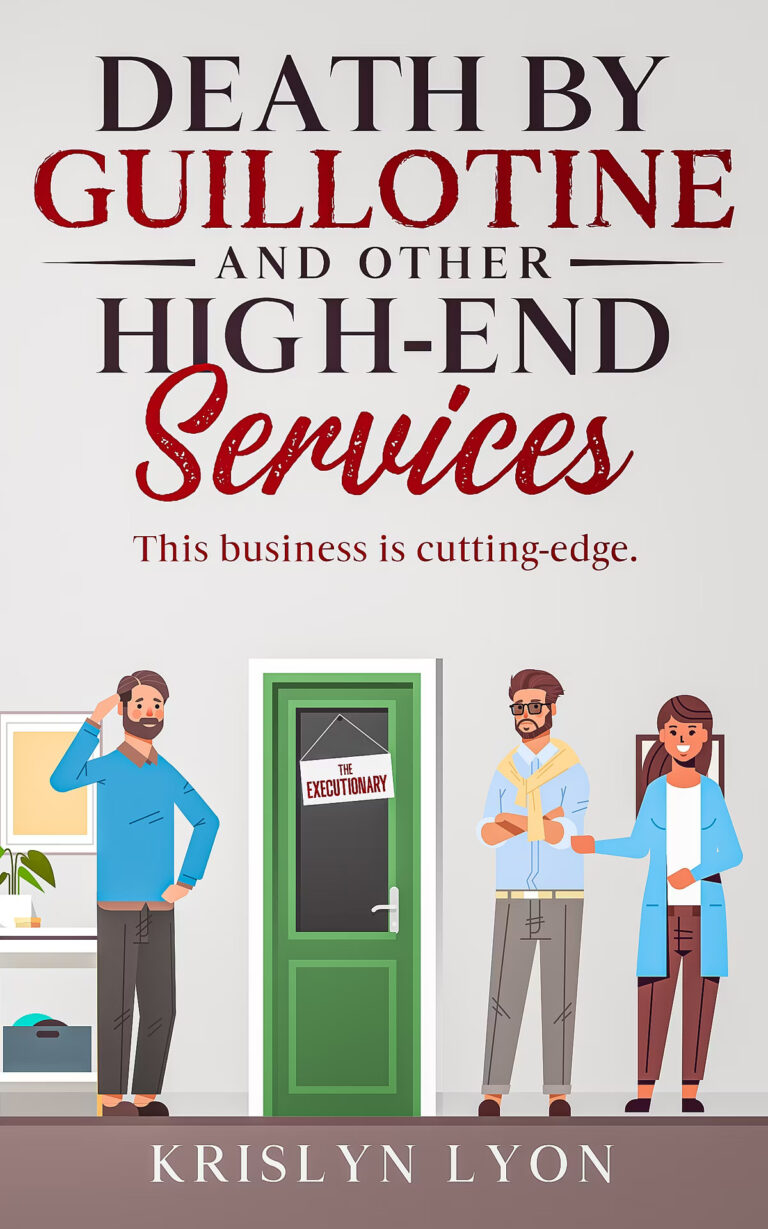
Author Submission Disclosure: This book was submitted by the author. Reviews on Four Eye Books are independent and unpaid, and reflect my genuine reading experience through the Four Lenses framework.
“The human race was truly inspiring in its continual ability to monetize the inhumane.” — Narrator
General Thoughts
I went into Death by Guillotine, and Other High-End Services cautiously curious. The book opens with both a trigger warning and a tongue-in-cheek disclaimer, which immediately signals the tone Krislyn Lyon is working with. The contrast feels very contemporary: part acknowledgment of the subject matter, part gallows humor, and part invitation to settle into something a little unsettling.
At its core, this novel reads like a dark workplace comedy built around an intentionally outrageous premise: a luxury execution service operating through a supposed legal loophole. The story isn’t aiming for realism. Instead, it leans fully into its own internal logic—using sharp dialogue, escalating scenarios, and morally flexible entrepreneurship to explore how systems can normalize the unthinkable.
What kept me engaged most, though, was the character dynamic. The energy between Dante and Gonzo reminded me of Clerks (1994, an American independent film directed by Kevin Smith), with its focus on conversation, banter, and morally ambiguous choices unfolding in everyday settings. At the same time, the exaggerated corporate logic and irreverent tone echoed the satirical systems found in Nino Cipri’s Litenverse.
I stayed engaged throughout, even as the tone shifted and stretched. The book commits fully to its premise, and that consistency carries the experience forward.
Lens on Story
At the center of the novel is the relationship between Dante and Gonzo, and their dynamic gives the book much of its narrative energy. Dante is the schemer—someone who sees opportunity everywhere and treats rules as obstacles to navigate rather than boundaries to respect. Gonzo, by contrast, is easier to connect with. His emotional vulnerability and quiet loneliness ground the story in something more human.
Their relationship is notably uneven. Gonzo finances Dante’s ideas, and that imbalance quietly shapes everything that follows. There is genuine friendship, but there is also a pattern of reliance that edges into exploitation. Dante thrives as the visionary, while Gonzo becomes the one who enables those visions to exist.
Gonzo ultimately becomes the emotional center of the book. His desire to feel chosen—to matter to someone—adds a layer of tenderness beneath the humor. That emotional thread explains why he continues to say yes, even when the plans they pursue move into increasingly questionable territory.
Michiko introduces another dimension. Her ambition and fixation on diamonds shift the tone slightly, bringing in something sharper and more calculated. Her presence expands the story beyond the central duo and adds complexity to the emotional and narrative landscape.
The plot escalates steadily, but the book never breaks from its own rules. That commitment to its internal logic is what allows the story to hold, even as it pushes further into unexpected territory.
Lens on Big Ideas
What unsettled me most wasn’t simply the premise, but how quickly it began to feel normal.
The novel explores how systems—particularly economic ones—reshape moral boundaries. What begins as an outlandish concept gradually becomes structured, justified, and even respectable within the world of the story. The logic holds just long enough that you stop questioning it—and that’s where the satire starts to feel less exaggerated and more familiar.
Dante’s perspective is central to this. He firmly believes there is still a moral boundary in place—that what they are doing is controlled, consensual, and legitimate. That insistence feels less like a defense and more like a reflection of how easily people adjust their ethics when something benefits them.
The book also touches on privilege. Dante and Gonzo are insulated in ways that allow them to take risks without fully confronting consequences. Their backgrounds—legacy admissions (a system where family connections influence acceptance), financial stability, and access—shape their confidence and their assumptions about how far they can go.
The fictional “Suicide Loophole of 1874” plays into this dynamic. It is presented with just enough authority to feel plausible, and for a moment, I found myself wondering if it might be real. That uncertainty becomes part of the commentary—how easily something can be accepted when it is framed convincingly.
There were moments where the humor leaned on stereotypes in ways that felt less like satire and more like a shortcut. When the book is sharp, it’s incisive. When it isn’t, it risks undercutting its own commentary.
Lens on Time & Place
Although the story is set in North Carolina, the setting itself feels secondary to the broader cultural moment the book reflects.
This novel feels rooted in a very specific contemporary context—one shaped by conversations around trigger warnings, reader sensitivity, and the boundaries of humor. The opening framing becomes part of that conversation, setting expectations while also challenging them.
While reading, I found myself thinking about the Death Positive movement. Over the past decade, voices like Caitlin Doughty have worked to encourage more open, thoughtful conversations about mortality. Through books like Smoke Gets in Your Eyes and platforms like Ask a Mortician, the goal has been to demystify death and offer alternatives to traditional funeral practices.
Because of that familiarity, the premise of this novel didn’t feel as shocking as it might otherwise. It is extreme, certainly, but the underlying idea—that people might seek more personalized, unconventional ways of approaching death—already exists in different forms. In that sense, the novel reads less like a complete departure and more like a dark exaggeration of conversations that are already happening.
For readers who are less familiar with these ideas, the premise may feel more jarring. But for me, the tension came not from the concept itself, but from how far the story was willing to push it—and how easily that progression began to make sense within its own logic.
By the end, the business expands and becomes normalized. What begins as an unusual idea evolves into something structured and widely accepted. The progression works because it never feels entirely disconnected from the systems we already recognize.
Lens on What It Sparks
What surprised me most while reading this book was how easily I settled into it.
Given the premise, I expected to feel more resistance. Instead, once I adjusted to the tone, I found myself leaning into the rhythm of the story. I was entertained—but also aware of how quickly that entertainment took hold.
I found myself laughing at moments that probably should have felt more uncomfortable—and sitting with that reaction afterward.
The story sparked comparisons to Clerks and to the Litenverse, both of which use humor and structure to explore systems through character-driven interactions. At the same time, it pushed me to think more about how we talk about death in contemporary culture, especially when placed alongside movements that encourage reflection rather than detachment.
My familiarity with the Death Positive movement also shaped my reaction. What might read as shocking to some felt, at times, like an exaggerated extension of ideas I’ve already encountered—just pushed into uncomfortable territory.
Gonzo stayed with me the most. Beneath everything, he is someone searching for connection and validation. That emotional thread adds depth to the story and raises questions about how loneliness, loyalty, and ambition shape the choices people make.
The book also made me think about the limits of satire. At what point does something stop feeling exaggerated and start feeling familiar? And how easily do we accept something once it has been framed in a way that makes sense?
Who Should Read This
- Readers who enjoy dark workplace comedies with morally complicated characters
- Fans of satire that explores systems, power, and shifting ethical boundaries
- Readers who appreciate dialogue-driven stories with strong character dynamics
- Those interested in stories that sit in tension between humor and discomfort
Recommendations
- Clerks (1994, an American independent film directed by Kevin Smith): A workplace comedy built around sharp dialogue and morally messy characters navigating absurd situations. The conversational rhythm and morally gray humor closely mirror the dynamic between Dante and Gonzo.
- Finna by Nino Cipri: A surreal, corporate satire set inside a big-box furniture store with multiverse chaos. Like Lyon’s novel, it explores how systems shape behavior and identity in unexpected ways.
- Defekt by Nino Cipri :A companion story that continues exploring bureaucracy and identity within the same strange corporate ecosystem, using speculative elements to examine relationships and self-perception.
- Smoke Gets in Your Eyes by Caitlin Doughty: A thoughtful exploration of death culture and the funeral industry, offering a grounded counterpoint to the novel’s satirical approach.
- Ask a Mortician (YouTube): An educational channel exploring death, history, and funerary practices with clarity and care, complementing the themes explored in this book.
- Order of the Good Death: A nonprofit promoting open and compassionate conversations about mortality, connecting directly to the broader cultural context surrounding the novel.
Author Bio
Krislyn Lyon is a multi-genre author who loves to engage with the magical, absurd, and unintentionally hilarious. She published her debut novel, For The Sake Of Ten Men, this year, and quickly followed it with her debut romantic comedy, Love In The Age Of Memes. She finds humor in everyday events and enjoys exploring the “what ifs” of life, spinning them into story.
She is currently working on a whimsical serial titled Quiverus The Unjust, which can be found on her Substack. More work is on the way—she’s always writing.
Learn more:
Support Four Eye Books
If this review sparked something for you—whether it’s curiosity, reflection, or a new book to pick up—you can support Four Eye Books in a few simple ways.
☕ Buy Me a Coffee (a platform for supporting creators): buymeacoffee.com/foureyebooks
📚 Follow on Instagram: www.instagram.com/foureyebooks
Your support helps keep this space thoughtful, independent, and growing.
Closing Thoughts
Death by Guillotine, and Other High-End Services is a strange, darkly humorous novel that asks an uncomfortable question: what happens when something as final as death becomes just another service?
What stayed with me wasn’t just the premise—it was how easily it began to make sense. How quickly the logic settled in.
And maybe that’s the point. Not just to laugh at the absurdity, but to recognize how close it feels to something real.
Turn the page, take the trip—what new perspective awaits?