
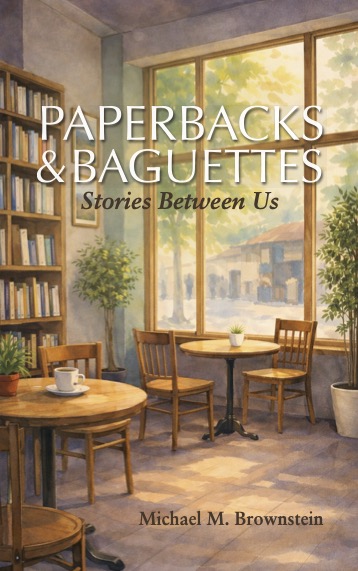
This book was submitted through Four Eye Books’ Feature process, and the author paid a Feature fee, which helps support this site. I’m grateful for that support, and for the trust it takes to share a book with me. Reviews are always independent, my honest opinion, and never influenced by whether an author has paid. What you’re reading reflects my genuine reading experience through the Four Lenses framework.
“The bell above the door catches once, then lets go.”
General Thoughts
Spending time at a café or bookstore reading is one of my favorite activities. I make a habit of going to one every weekend. There are a few I frequent, but I’m always looking for new places. Whenever my wife and I travel, we find a local coffee shop where I can read while she works on her art. Just being in that environment centers me, especially after a long week. When this review request arrived, I said yes right away.
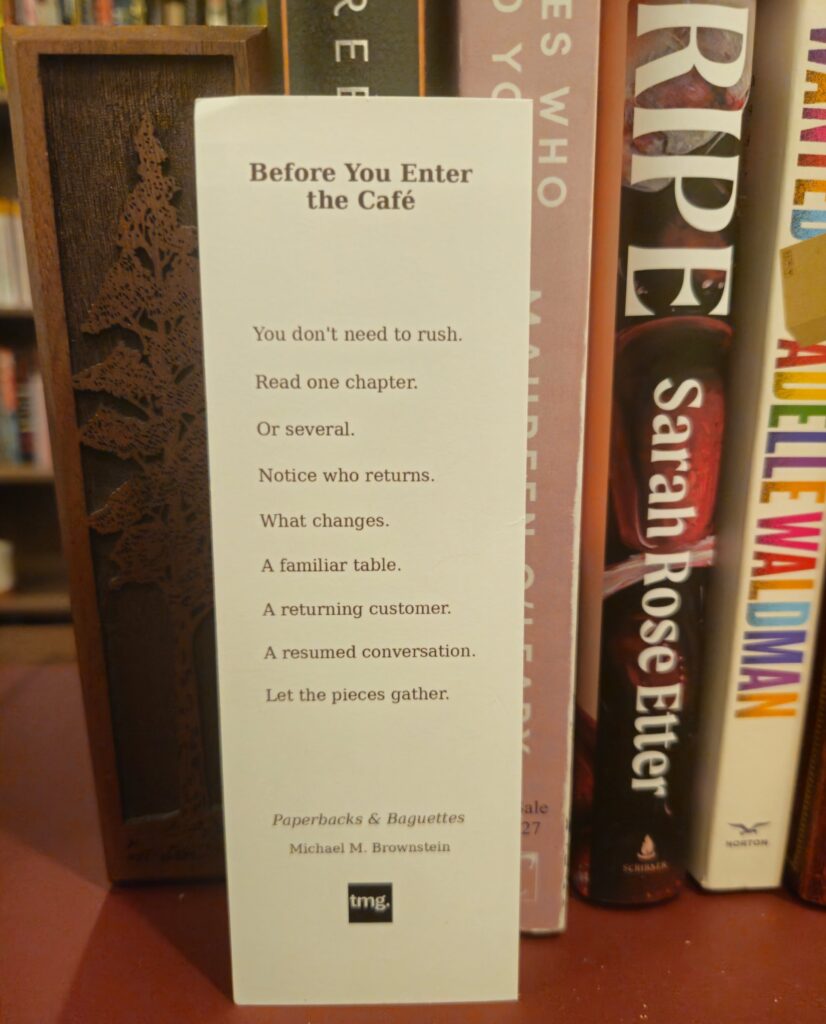
When the book came and I started flipping through the pages, a bookmark fell out. One side held a piece of the cover art. The other side was a list titled “Before You Enter the Café,” and its first line was “You don’t need to rush.” The rest read like quiet instructions: “Notice who returns. What changes.” It set the tone right away. I knew I was going to enjoy this book.
This is one of those few books that speak to my soul, to who I am and who I aspire to be. It challenges you to be present. The beauty is in the everyday details. I was so entranced that I didn’t want to finish too soon, but I couldn’t stop reading.
Lens on Story
The publisher puts it simply: the book “follows the people inside — and the traces they leave behind.” It’s a collection of short vignettes, all set in and around one bookstore café. Each chapter has a title and a subtitle. There are no character names, just the people. Not a lot happens.
The connections between the stories are subtle: a book that keeps coming back to the same shelf, a playlist someone keeps missing. Someone catches a conversation in the background, or just outside of earshot, and later you hear the rest of it. In “The First Rush,” someone asks about a playlist and the question gets “lost in the hum of the milk wand”; in the next chapter, a man at closing says, “You missed the good playlist.” In “Playlist Notes,” she asks, “Testing for the Bastille thing?” A few pages later, “Croissants at Eight” opens on Bastille Day, France’s national holiday on July 14.
There is a cast of characters, but the woman in the scarf appears again and again, alone and with the man behind the counter. That thread became clearer the more I read. In “Halfway Across,” when he finally sees her outside, “it was the first time he’d seen her without the store between them.” Their story is intimate and very cute, like an indie-film romance.
Near the middle of the book, “The Seam” shows the store’s two sides, the café and the bookstore, as two different realities.
The no-names choice mostly works for me. In real life, we rarely know the names of the people we share a café with, and the book honors that. But it has a cost, and I felt it in two places.
The first is “Left Unsaid” and “Between Orders.” They sit back to back and open almost the same way: a woman with paperwork, a mug beside her, not looking up, while a man speaks from somewhere else. With no names, “she” and “he” carry everything, so it reads like one scene continuing, but it’s two different women. In the first, she’s a bookseller at the register and he’s the one in the back office. In the second, she’s the general manager, and the back office is hers. I had to slow down and sort out who was who. “Held Its Shape” does something similar, with “she” shifting between three different women in a few pages.
The second is the layout of the store itself, which was hard to picture. There’s a café side, a bookstore side, a back office, and an upstairs, and a downstairs space appeared halfway through. I never quite built the map in my head. There were stories I didn’t understand the first time. I think this book asks for more than one read.
Lens on Big Ideas
This book is about what is. Its meaning is presence, being in the moment.
Space is central to these stories. The bookstore café is a living, breathing space that keeps shaping and reshaping itself. “Sometimes it feels like the room exhales before anyone speaks.” In one scene, two people hold still at a table: “For a moment neither of them moved. Only the shop did.” It is both a community space and a place for quiet, personal connection. Partway through, the stories shift from the space itself to what happens when something in it changes, and how customers and workers both feel that tension. One line says it best: “Rooms collect what people leave unsaid.”
As much as I enjoyed the stories about the people, I enjoyed the ones about objects just as much. They’re intimate, personal, and almost archaeological. Each object has a story, and the book invites readers to think about the things left behind and the people who left them. It starts on the very first morning, in “Before the Day Starts,” with a postcard someone left leaning against a stack of travel guides: “The handwriting was small, deliberate. He read one line and stopped, not wanting to take more from it than what had been offered.” A few lines later, a returned book’s spine is “creased in a way that suggested someone had carried it in a bag, maybe read it at a kitchen table with a cup beside them.”
In “Cup Left Warm,” a staff member simply keeps an eye on a table to see if the customer will return: “When she passed again, she slowed, but left it the same.” It ends with the steam gone and “the chair was still angled out.” In “Notebook Forgotten,” an unclaimed journal with no name holds a single line, “don’t forget how it felt,” and the staff keep it “somewhere visible” in case its owner comes back. In “Rain Check,” an umbrella no one claims stays for weeks: “By winter, no one remembered whose it was. The room simply felt incomplete without it.” And in “The Folded Page,” two strangers reach for the same book, hers stiff and new, his worn with a corner folded. “Someone marked a place,” he says. She answers, “Maybe that’s where I’d stop too.”
I loved the stories told from the staff’s view: the operations, the people who really take care of a place. They walk by and adjust a shelf, fix up the kids’ area, and help each other out. In “Left Unsaid,” a bookseller straightens the toddler mirror in the children’s section and turns a flap book “slightly forward. Not flashy. Just visible.” That kind of care usually goes unseen.
Connecting with others doesn’t need to be something grand. Glances, touches, brief interactions are all it takes. That is the value of a third place, the term sociologist Ray Oldenburg used for places like cafés and bookstores, somewhere between home and work.
Lens on Time and Place
The book has an autumn feeling, in the season and in the mood. It moves through a year, frost to summer heat to winter rain, but it never loses that feeling.
It reads like an impressionist painting. It’s less about plot or characters and more about close, careful details of objects and place. There is a lot of time spent on the light, the smells, the sounds, and the shape of the space. “A thin thread of cinnamon and steam hung above the grinder, sweet as paper left too close to heat.” At closing, “the air carried cinnamon and bleach, the twin scents of ending.”
The language lingers. It stretches. The image of chairs “angled in clusters like conversations paused mid-sentence” is astounding. So is “By late afternoon the room had thinned, quiet collecting where voices had been.”
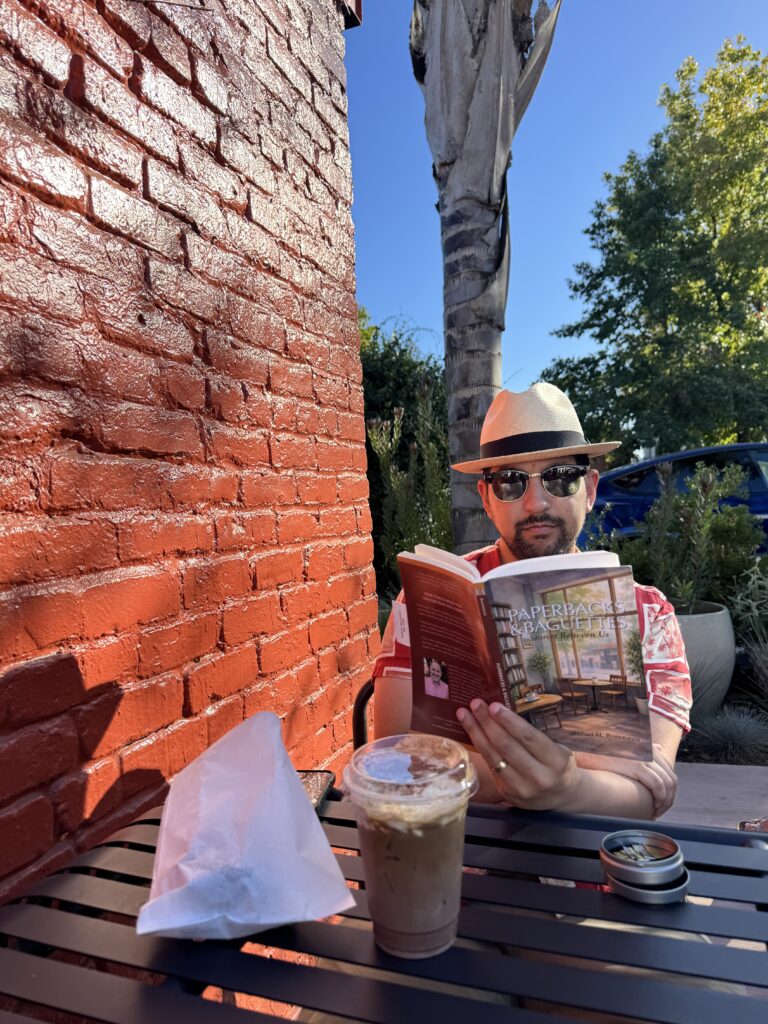
I read one chapter in one of my favorite coffee shops, at a different time of day than I normally go. The woman on the page was doing the same: “She came at odd times.” What was on the page was all around me: friends at their laptops, the espresso machines, music thrumming in the background. A wonderful sense of immersion.
I didn’t expect “Croissants at Eight” to send me searching, but it did. Why would this café celebrate Bastille Day? My first guess was French Canada. Then I read the author bio and saw that he lives in Massachusetts, where a few places celebrate it in solidarity with France. The book never names its town, and I liked having to wonder.
Lens on Reflection
I used to spend more time just watching, listening, observing. I still look for a quiet place to sit, a bench or a corner of a café, just not as often as I’d like. Usually I have an audiobook or something playing in my headphones. When I put them away, I feel centered. I just watch and listen, mindful and present to the world around me. Observing is one of my strengths as an introvert, and with the busyness of life it’s an easy one to forget.
When I make the time, I see the ebb and flow of people just living their lives. In the evenings, a sea of laptops and over-the-ear headphones. In the mornings, a group of seniors at their daily meetup, or friends getting coffee after a run. A barista calls someone by name and you know they’re a regular. Everyone has their own story, and you never know what journey someone is on. Even the playlist changes if you stay long enough: today it went from 1980s hits to pop to Michael Bublé.
This book reminded me of that part of myself, and I need to reconnect with it. I encourage you to do the same. Just sit, watch, listen.
Recommendations
There is something special about independent coffee shops and bookstores.
- Read next: The Monk & Robot series by Becky Chambers, for the same cozy feeling and the same pull to come back.
- Visit: A Seat at the Table in Elk Grove, California, near Sacramento, a community-focused, LGBT-owned independent bookstore that works hard to create a safe place for the community to just be and connect.
- Find your own: In the US, try the IndieBound Indie Bookstore Finder or the Libro.fm bookstore map, which lets you filter for stores whose owners identify as LGBTQ+, Black, Indigenous, women, and more. Elsewhere, ask your local indie bookstore or library.
Closing Thoughts
Paperbacks & Baguettes didn’t just connect with me. It hit me to my core. It sent me back to my favorite coffee shop, headphones off. I’ll come back to it, probably in a different season, and notice what I missed.
The last chapter, “The Far End of the Market,” leaves the café for a weekend market, where the woman in the scarf and the man share a fig at a coffee cart. It still echoes the first page: “If you stay long enough, the room starts remembering you back.”
Turn the page, take the trip—what new perspective awaits?
Author Bio

Michael M. Brownstein writes about the things we almost miss—the small gestures, conversations, and ordinary encounters that often reveal more than we expect. Much of his work begins with paying attention to everyday life and asking what those details reveal about how people know, remember, and care for one another. His work has appeared in The Interstitial, Catharsis Chronicles, and The Lark, among other online journals. He is an editor for New Choices and Scrittura. Michael lives with his family in Massachusetts and can usually be found making coffee and easing into the day. Learn more at themindfulguypublishing.com.
Support Four Eye Books
If you appreciate thoughtful, reflective reviews like this one, consider supporting Four Eye Books.
- 💛 Buy Me a Coffee: Every donation helps cover hosting, design, and accessibility tools for the blog. You can also become a monthly supporter to help this project grow sustainably.
- 📸 Instagram: Follow along for behind-the-scenes posts, travel adventures, and reading reflections.
Your support helps keep this space thoughtful, independent, and growing.